Many commerce students believe that becoming a tax professional simply means learning how to file Income Tax Returns or GST Returns.
In reality, the taxation profession is much broader and more dynamic.
Today’s tax professionals are expected to do much more than compliance filing. Businesses rely on them for:
- Tax compliance management
- GST and Income Tax advisory
- Documentation support
- Notice handling
- Tax planning assistance
- Regulatory guidance
As taxation laws become more complex, the demand for skilled tax professionals continues to grow.
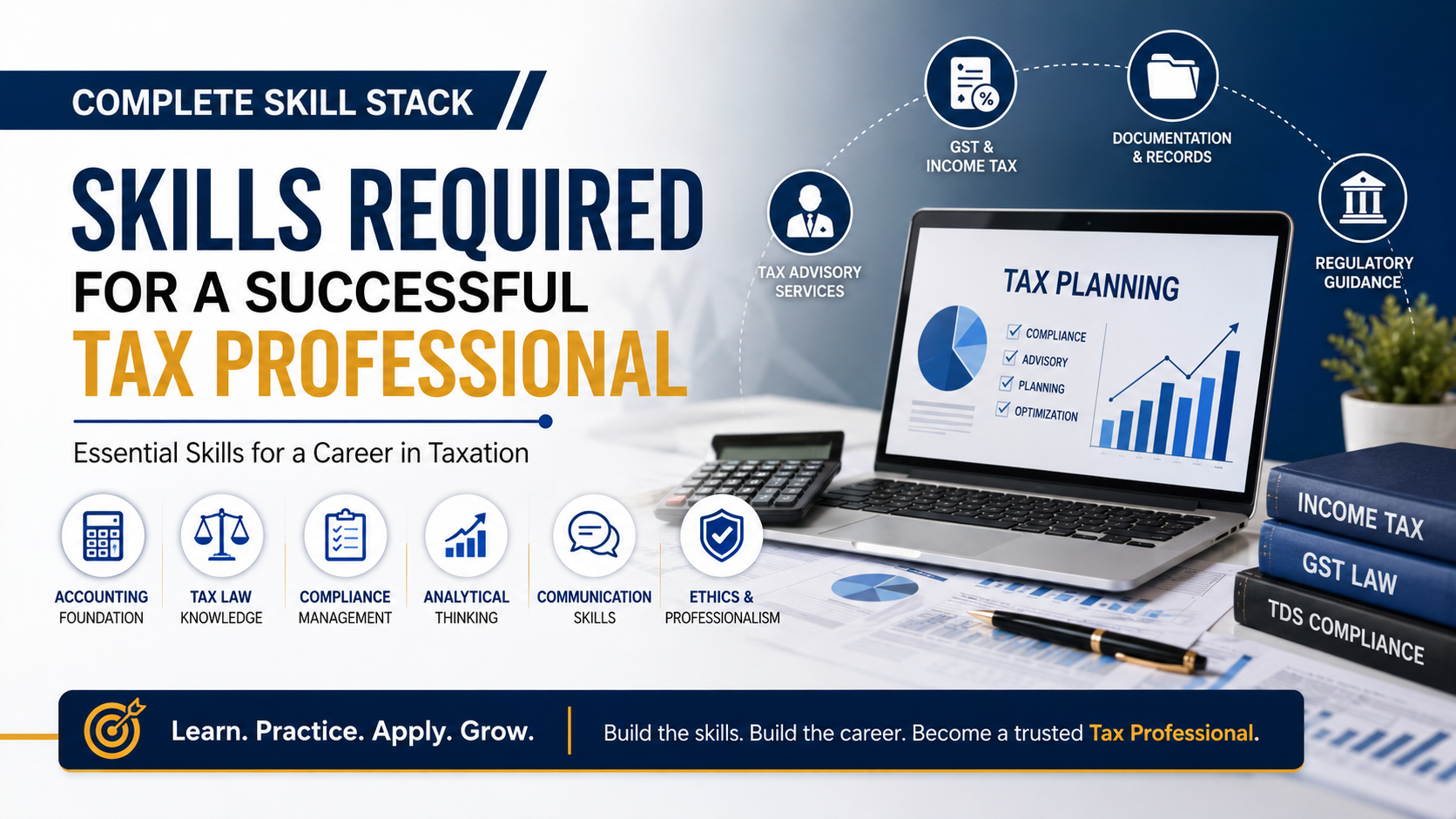
A successful tax professional is not defined by a single qualification or certification. Instead, success depends on developing a complete skill stack that combines accounting knowledge, tax law understanding, analytical thinking, compliance expertise, communication skills, and professional ethics.
This article explores the essential skills required for a successful career in taxation and explains how commerce students can systematically develop them.
Watch the Complete Video Explanation
This topic has also been explained in detail through our video session. Watch the complete explanation to understand how internships and professional courses work together to build practical expertise in accounting and taxation.
Understanding the Modern Tax Profession
Before discussing individual skills, it is important to understand how the taxation profession functions in practice.
A tax professional may regularly handle:
- Income Tax Return Filing
- GST Return Compliance
- TDS and TCS Compliance
- Tax Notice Handling
- Tax Assessments
- Compliance Management
- Tax Advisory Services
- Business Tax Planning
This means taxation is not only about law.
It is a profession that combines:
- Accounting
- Compliance
- Documentation
- Communication
- Technology
- Legal Understanding
Students who focus only on theoretical concepts often struggle when faced with practical situations.
Skill 1: Strong Accounting Foundation
Why Accounting is Important in Taxation
Accounting forms the backbone of every taxation activity.
Most tax calculations begin with financial records such as:
- Profit and Loss Account
- Balance Sheet
- Ledger Accounts
- Books of Accounts
- Business Transactions
Without understanding financial data, it becomes difficult to identify:
- Taxable income
- Business expenses
- GST implications
- TDS applicability
- Compliance risks
Practical Example
A tax professional reviewing accounts should be able to identify:
- Personal expenses recorded as business expenses
- Unrecorded income
- Incorrect GST treatment
- TDS compliance issues
For this reason, practical accounting knowledge is one of the most important skills for a taxation career.
Skill 2: Understanding Income Tax and GST Laws
Every tax professional must develop a practical understanding of:
- Income Tax Act
- GST Law
- TDS Provisions
- TCS Provisions
- Compliance Procedures
The goal is not to memorize every section.
Instead, professionals should understand:
- When a provision applies
- What compliance is required
- Which documents are needed
- What penalties may arise from non-compliance
Practical interpretation is more valuable than rote memorization.
Skill 3: Compliance Management Skills
Taxation is heavily driven by deadlines and regulatory compliance.
Professionals regularly manage:
- Income Tax Returns
- GST Returns
- TDS Returns
- Audit Reports
- Compliance Certificates
- Regulatory Filings
Strong compliance management requires:
- Time Management
- Documentation Systems
- Deadline Tracking
- Client Follow-up Processes
Professionals who build efficient systems can handle large volumes of compliance work effectively.
Skill 4: Analytical Thinking and Problem Solving
Taxation often requires careful analysis rather than straightforward answers.
Professionals must evaluate questions such as:
- Is this expense deductible?
- Is this income taxable?
- Does GST apply?
- Is TDS required?
Analytical thinking helps professionals apply legal provisions to real-world situations.
Example
When examining a payment transaction, a tax professional may need to determine:
- Nature of the transaction
- Applicable tax law
- Required compliance
- Documentation requirements
This ability to interpret facts logically separates strong professionals from average practitioners.
Skill 5: Tax Notice Handling Skills
One of the most valuable skills in taxation is the ability to handle departmental notices.
Businesses frequently receive notices regarding:
- Return mismatches
- Compliance deficiencies
- Assessment proceedings
- Data discrepancies
- Verification requests
A competent tax professional should know how to:
- Interpret the notice
- Collect supporting documents
- Analyze the issue
- Draft structured responses
- Present explanations effectively
Notice handling combines technical knowledge with practical problem-solving.
Skill 6: Communication Skills
Tax professionals interact with:
- Clients
- Business Owners
- Accountants
- Government Authorities
- Consultants
Therefore, communication skills are essential.
Professionals must be able to:
- Explain complex tax matters simply
- Guide clients on compliance obligations
- Respond professionally to queries
- Draft clear communications
Strong communication builds trust and strengthens client relationships.
Skill 7: Technology and Digital Tax Systems
Modern taxation is increasingly technology-driven.
Tax professionals regularly work with:
- Income Tax Portal
- GST Portal
- Accounting Software
- Compliance Software
- Data Reconciliation Tools
- Reporting Systems
As automation continues to expand, technological proficiency has become a core professional requirement.
Students should become comfortable with digital systems early in their careers.
Skill 8: Professional Ethics and Integrity
Tax professionals handle highly sensitive financial and legal information.
Therefore, ethics plays a critical role in professional success.
Key ethical responsibilities include:
- Maintaining confidentiality
- Following legal requirements
- Providing accurate advice
- Avoiding unethical practices
- Acting in the client’s best interest
Professional integrity builds long-term credibility and trust.
How Commerce Students Can Build This Skill Stack
Students often ask how they can develop these skills effectively.
A practical roadmap includes:
Step 1: Learn Practical Accounting
Develop strong accounting fundamentals through practical training.
Step 2: Study Taxation Practically
Learn GST, Income Tax, TDS, and TCS using real examples.
Step 3: Gain Internship Exposure
Observe how tax professionals handle actual compliance and client work.
Step 4: Practice Real Case Studies
Work on practical scenarios to improve decision-making ability.
Step 5: Develop Communication and Documentation Skills
Focus on professional drafting and client interaction. The earlier students begin developing these skills, the stronger their career foundation becomes.
Why Practical Training Matters in Taxation
Many commerce students possess theoretical knowledge but lack practical exposure.
Practical taxation training helps students understand:
- Real compliance workflows
- Live portal operations
- Documentation procedures
- Notice handling processes
- Client communication practices
Students who combine theory with practical learning are generally more job-ready and confident.
Why Students Choose Mantra E Learning for Taxation Training
At Mantra E Learning, students learn taxation through practical, industry-oriented training.
Our programs include:
- Practical Accounting Training
- GST Compliance Training
- Income Tax Return Filing
- TDS and TCS Procedures
- Live GST Portal Practice
- Live Income Tax Portal Training
- Original Business Documents
- Real Case-Based Learning
The focus is on developing complete professional competence rather than only theoretical knowledge
Frequently Asked Questions (FAQs)
What skills are required to become a tax professional?
A successful tax professional needs accounting knowledge, tax law understanding, compliance management skills, analytical thinking, communication ability, technology proficiency, and professional ethics.
Is accounting important for taxation?
Yes. Accounting forms the foundation of tax computation, compliance, and financial analysis.
How can commerce students start a career in taxation?
Students should learn accounting, GST, Income Tax, and compliance procedures while gaining practical exposure through internships and professional training.
Are communication skills important for tax professionals?
Yes. Tax professionals regularly interact with clients, authorities, and business owners, making communication an essential skill.
Can practical training improve job opportunities in taxation?
Absolutely. Employers prefer candidates who can apply knowledge in real-world situations and handle compliance work confidently.
Conclusion
A successful tax professional is not defined by a single qualification, course, or technical concept.
Success in taxation comes from building a complete skill stack that includes:
- Accounting Knowledge
- Tax Law Understanding
- Compliance Management
- Analytical Thinking
- Notice Handling Skills
- Communication Ability
- Technology Awareness
- Professional Ethics
Commerce students who begin developing these skills early create a strong foundation for long-term professional success.
Taxation is more than a subject—it is a profession built on knowledge, responsibility, continuous learning, and practical expertise.
Start Building Your Taxation Skill Stack with Mantra E Learning
Gain practical expertise in Accounting, GST, Income Tax, TDS, TCS, Compliance Management, and Professional Tax Practice through industry-oriented training.
Contact: 7041503603
Mantra E Learning – Practical Accounting & Taxation Training with Live Portals, Real Documents, and Career-Focused Learning.