
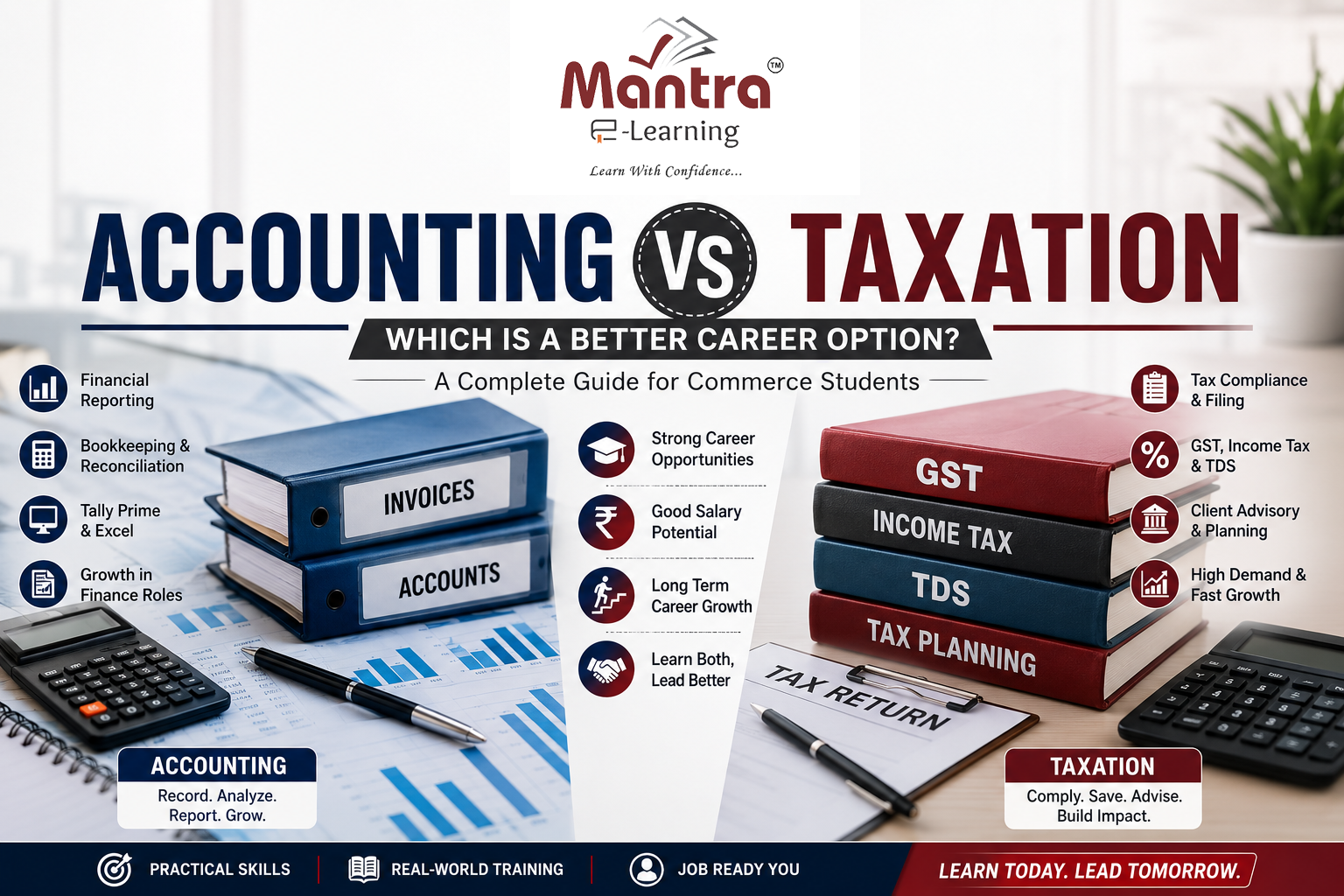
Choosing between accounting and taxation can be confusing for commerce students and fresh graduates. Both fields offer career opportunities, but the nature of the work, required skills, client interaction, and career progression can be quite different.
If you have completed or are pursuing B.Com, M.Com, or another commerce-related qualification, you may have questions like:
- Is accounting a better career than taxation?
- Which field has better salary growth?
- What skills are required for accounting jobs?
- Is taxation more difficult than accounting?
- Should I learn accounting and taxation together?
The good news is that you don’t necessarily have to choose one immediately. Understanding the difference between accounting and taxation can help you decide which area matches your interests, strengths, and long-term career goals.
What Is the Difference Between Accounting and Taxation?
At a basic level, accounting focuses on recording, organising, and reporting financial transactions, while taxation focuses on calculating tax liabilities, complying with tax laws, filing returns, and helping businesses and individuals meet their tax obligations.
For example, an accountant may record a company’s sales and purchase transactions, reconcile its bank account, and prepare financial statements.
A tax professional may use financial information from the business to prepare GST returns, Income Tax computations, TDS compliance, or respond to tax-related requirements.
In a real business environment, however, these two areas are closely connected.Good accounting information makes taxation work easier, while a basic understanding of taxation helps accountants handle business transactions more effectively.
Accounting as a Career
Accounting is one of the most established career paths for commerce graduates.
The primary responsibility of an accounting professional is to maintain accurate financial records and ensure that business transactions are properly recorded and reported.
What Does an Accountant Actually Do?
Accounting work can include:
- Recording daily business transactions
- Maintaining ledgers
- Preparing vouchers
- Managing accounts payable and receivable
- Bank reconciliation
- Preparing trial balances
- Maintaining books of accounts
- Assisting with financial statements
- Supporting month-end and year-end finalisation
- Maintaining accounting documentation
The work is generally structured and requires consistency, accuracy, and attention to detail.
Skills Required for Accounting Jobs
Students interested in accounting should develop practical skills such as:
Tally Prime – for bookkeeping and accounting entries.
Microsoft Excel – for reports, calculations, reconciliation, and data analysis.
Bank Reconciliation – for matching bank statements with accounting records.
Financial Statements – understanding and preparing basic financial reports.
Bookkeeping – maintaining accurate records of business transactions.
Accounting Fundamentals – strong knowledge of journal entries, ledgers, trial balance, and other core concepts.
Learning these skills practically can make a significant difference when applying for entry-level accounting positions.
Common Accounting Career Options
| Job Role | Typical Responsibilities | Key Skills Required | Career Level |
|---|---|---|---|
| Accounts Assistant | Basic accounting entries, vouchers, documentation, and record maintenance | Basic Accounting, Tally Prime, Excel | Entry Level |
| Junior Accountant | Bookkeeping, ledger maintenance, bank reconciliation, and basic reporting | Accounting, Tally Prime, Excel, Reconciliation | Entry Level |
| Accounts Executive | Managing day-to-day accounting, invoices, payments, receipts, and reports | Tally Prime, Excel, GST Basics, Accounting | Entry to Mid Level |
| Accountant | Maintaining complete books of accounts, reconciliations, reporting, and supporting finalisation | Accounting, Tally Prime, Excel, Financial Statements | Mid Level |
| Senior Accountant | Reviewing accounts, handling complex transactions, finalisation, and supervising accounting activities | Advanced Accounting, GST, Tally Prime, Excel, MIS | Senior Level |
| Finance Executive | Financial reporting, budgeting support, analysis, and finance-related operations | Excel, Financial Analysis, MIS, Accounting | Mid Level |
| Finance Manager | Managing finance operations, financial planning, reporting, controls, and team supervision | Financial Management, Analysis, Leadership, Reporting | Senior Management |
Taxation as a Career
Taxation is another strong career option for commerce graduates who are interested in tax laws, compliance, problem-solving, and client advisory work.
Unlike routine bookkeeping, taxation can involve changing regulations, deadlines, documentation, return filing, and practical problem-solving.
What Does a Tax Professional Do?
Tax-related work can include:
- GST return preparation and filing
- Income Tax return preparation
- TDS compliance
- Tax computation
- GST reconciliation
- Tax documentation
- Tax-related research
- Responding to certain notices and communications
- Assisting clients with compliance requirements
- Providing tax-related guidance within the professional scope
For someone who enjoys learning regulations and solving practical financial problems, taxation can be an interesting career path.
Skills Required for Taxation Jobs
| Skill | What You Should Know | Why It Matters |
|---|---|---|
| GST Knowledge | GST concepts, compliance requirements, input tax credit, and return filing processes | Helps handle routine GST compliance and return-related work |
| Income Tax Knowledge | Income computation, deductions, tax calculations, and Income Tax return preparation | Essential for handling individual and business tax-related work |
| TDS Knowledge | TDS deduction, payment, return filing, and basic reconciliation | Helps manage regular TDS compliance requirements |
| Tax Research | Understanding applicable laws, rules, notifications, circulars, and regulatory updates | Tax regulations can change, so professionals need to stay updated |
| Documentation | Maintaining invoices, statements, supporting documents, working papers, and compliance records | Proper documentation helps maintain accurate and well-supported tax records |
| Communication Skills | Explaining tax requirements, issues, and compliance matters clearly to clients and colleagues | Important for client handling and professional communication |
| Tax Portal Skills | Using relevant government portals for GST, Income Tax, TDS, and other online compliance processes | Practical portal knowledge helps professionals perform actual compliance work efficiently |
Accounting vs Taxation: Key Differences
The difference becomes easier to understand when you compare the nature of work.
| Factor | Accounting | Taxation |
| Main focus | Financial records and reporting | Tax compliance and advisory |
| Typical work | Bookkeeping, reconciliation, finalisation | GST, Income Tax, TDS and compliance |
| Work style | Structured and process-oriented | More dynamic and regulation-driven |
| Client interaction | Can be moderate | Often higher |
| Important tools | Tally Prime, Excel | Tax portals, Excel, accounting software |
| Key knowledge | Accounting principles | Tax laws and compliance |
| Problem-solving | Financial records and reconciliations | Tax and compliance-related issues |
| Career options | Accountant, Accounts Executive, Finance Executive | Tax Executive, GST Executive, Tax Consultant |
| Specialisation | Accounting, finance, reporting | GST, Income Tax, TDS, tax advisory |
Neither field is automatically better for everyone.
The right choice depends on what kind of work you enjoy and what type of career you want to build.
Is Accounting Easier Than Taxation?
For many beginners, accounting can feel easier to start with because the workflow is relatively structured.
You learn the accounting principles, understand transactions, record them correctly, reconcile accounts, and prepare reports.
Taxation can feel more dynamic because tax laws, compliance requirements, deadlines, and procedures require continuous learning.
However, difficulty should not be the main factor when choosing a career.
A field that seems difficult initially can become much easier once you gain practical experience.
Instead of asking:
“Which field is easier?”
A better question is:
“Which type of work am I interested in learning deeply?”
Which Has Better Salary and Career Growth: Accounting or Taxation?
This is one of the most common questions asked by students.
There is no single salary figure that applies to everyone.
Career growth depends on factors such as:
- Practical skills
- Work experience
- Qualifications
- Industry
- Location
- Job responsibilities
- Specialisation
- Communication skills
- Ability to handle clients and compliance work
Accounting can offer a stable and structured career path, especially for professionals who develop strong bookkeeping, reporting, financial analysis, and accounting software skills.
Taxation can offer opportunities for specialisation, particularly for professionals who build strong knowledge of GST, Income Tax, TDS, compliance, and tax-related advisory work.
As experience increases, professionals in either field can move into senior positions or develop specialised careers. For some professionals, taxation can also eventually provide a pathway toward independent consultancy, subject to the applicable professional and legal requirements.
Can You Learn Accounting and Taxation Together?
Yes — and for many commerce students, this can actually be the most practical approach.
Accounting and taxation are closely connected.
Consider a simple example.
A business makes sales and purchases.
First, those transactions need to be properly recorded in the books of accounts.
Then, the relevant financial and transaction data may be required for GST compliance.
Similarly, accounting records can become important when preparing Income Tax computations and other compliance work.
This means a professional who understands both accounting and taxation can often see the complete picture of a business’s financial and compliance requirements.
That combination can be particularly useful for students looking to work in:
- CA firms
- Tax consultancy firms
- Accounting firms
- Small and medium-sized businesses
- Corporate accounting departments
- Finance departments
- GST and tax compliance roles
Which Career Should Choose?
There is no universal answer.
Your interests and working style should play an important role.
Choose Accounting If You Enjoy:
- Structured work
- Numbers and financial records
- Bookkeeping
- Reconciliation
- Financial statements
- Working with accounting software
- Organised, process-driven tasks
If you enjoy understanding how a business’s financial transactions come together, accounting may be a good fit.
Choose Taxation If You Enjoy:
- Problem-solving
- Learning rules and regulations
- GST and Income Tax
- Compliance work
- Client interaction
- Research
- Handling different situations
- Dynamic work
If you enjoy solving tax-related problems and communicating with clients, taxation may suit you better.
Still Confused?
Then don’t rush into choosing only one.
Build a foundation in both accounting and taxation first.
After gaining practical exposure, you will have a much clearer idea of which area you want to specialise in.
Why Practical Skills Matter More Than Just Theoretical Knowledge
A commerce degree provides an important academic foundation.
But employers often need candidates who can apply that knowledge to actual work.
For example, knowing the definition of bank reconciliation is different from actually reconciling a company’s bank statement.
Knowing what GST is is different from preparing GST data and understanding the return filing process.
Knowing Income Tax provisions from a textbook is different from working through a practical tax computation.
This is why practical accounting and taxation skills can be valuable for commerce students and freshers.
The combination of:
Degree + Accounting Skills + Taxation Skills + Software Knowledge + Practical Exposure
can make a candidate considerably more workplace-ready.
What Should You Learn to Build a Career in Accounting and Taxation?
| Skill / Area | What You Should Learn | Career Benefit |
|---|---|---|
| Accounting Fundamentals | Journal entries, ledgers, trial balance, bookkeeping, and financial statements | Builds a strong foundation for accounting and finance roles |
| Tally Prime | Day-to-day accounting entries, vouchers, ledgers, GST-related entries, and business reports | Helps you perform practical accounting work using accounting software |
| Microsoft Excel | Formulas, lookup functions, Pivot Tables, reconciliation, reporting, and MIS | Improves efficiency in accounting, reporting, and data analysis |
| GST | GST concepts, input tax credit, compliance, and practical processes related to GSTR-1 and GSTR-3B | Prepares you for GST compliance and accounting-related roles |
| Income Tax | Income computation, deductions, tax calculation, and basic Income Tax return preparation | Develops practical knowledge for tax-related work |
| TDS Compliance | TDS deduction, payment, return filing, and basic reconciliation | Helps handle regular TDS compliance responsibilities |
| Communication Skills | Professional communication, client interaction, explaining financial information, and workplace communication | Builds confidence for interviews, client handling, and professional growth |
Accounting vs Taxation: Which One Is Better?
The answer is simple:
Neither accounting nor taxation is universally better.
Accounting can be a strong option for students who prefer structured financial work, bookkeeping, reconciliation, and reporting.
Taxation can be a strong option for students who enjoy compliance, regulations, problem-solving, client interaction, and specialised knowledge.
But if you’re starting your career, there is another option that can give you greater flexibility:
Learn Both.
Understanding accounting first and then building practical taxation knowledge can give you a broader understanding of how businesses manage their finances and compliance. Over time, you can decide whether you want to specialize in accounting, taxation, finance, GST, Income Tax, or another related area
Start Building Practical Accounting & Taxation Skills
At Mantra E Learning, the focus is on helping commerce students move beyond theoretical knowledge and develop practical workplace skills.
The learning approach covers areas such as Tally Prime, practical accounting, GST, Income Tax, TDS, and Excel, with an emphasis on understanding how these skills are applied in real-world situations.
If your goal is to become more confident for accounting or taxation roles, explore Mantra E Learning’s Practical Accounting & Taxation Training and start building skills that go beyond textbook knowledge.