A B.Com or M.Com degree can open the door to a job interview, but practical skills can help you walk through it with confidence. For commerce students and fresh graduates, the gap between academic knowledge and workplace requirements is becoming increasingly important.
Many students complete their B.Com or M.Com, understand accounting concepts, study taxation, and prepare thoroughly for examinations. Yet, when they face an interview, a common question can create uncertainty:
“Can you actually handle the work?”
This is where practical accounting and taxation skills make a significant difference.
Watch the Complete Video Explanation
This topic has also been explained in detail through our video session. Watch the complete explanation to understand how internships and professional courses work together to build practical expertise in accounting and taxation.
Degree vs Skills: What Do Employers Really Look For?
A degree is important. It provides the academic foundation needed to understand commerce, accounting, taxation, business, and finance.
However, employers often need more than theoretical knowledge.
An accounting or taxation job may require a candidate to work with:
- Tally Prime
- GST return filing
- Income Tax return preparation
- TDS compliance
- Excel and accounting reports
- Bank reconciliation
- Basic accounting entries
- Client communication
- Documentation and compliance work
Knowing the definition of GST from a textbook is different from actually preparing GST data for a business.
Similarly, understanding the concept of a balance sheet is different from being able to prepare, review, and interpret one using real business transactions.
Education builds the foundation. Practical skills build workplace readiness.
Why Commerce Graduates Struggle With Their First Job
One of the biggest challenges faced by fresh commerce graduates is the theory-to-practice gap.
Students spend years studying subjects such as accounting, taxation, auditing, and financial management. But classroom learning may not always provide enough exposure to the type of work performed in an accounting office, CA firm, tax consultancy, or business.
For example, a student may know what GST is but still be unfamiliar with:
- Preparing sales and purchase data
- Understanding input tax credit
- Reconciling GST data
- Preparing GSTR-1 information
- Working with GSTR-3B data
- Identifying common errors
- Handling practical documentation
The same applies to Income Tax, TDS, Excel, and accounting software.
This doesn’t mean that academic education is useless.
It means that academic knowledge and practical training need to work together.
What Practical Skills Should a Commerce Student Learn?
If your goal is to build a career in accounting, taxation, finance, or compliance, developing practical skills can significantly improve your job readiness.
1. Tally Prime and Practical Accounting
Tally Prime is widely used for accounting and business operations.
A job-ready candidate should understand more than simply navigating the software.
Practical training should include areas such as:
- Ledger creation
- Sales and purchase entries
- Receipt and payment entries
- Journal entries
- Bank reconciliation
- Inventory basics
- GST-related accounting
- Financial reports
- Trial balance and balance sheet
The objective is simple: learn how accounting software is used to perform actual business work.
2. GST Return Filing
GST is an important practical area for accounting and taxation professionals.
Students should understand how GST compliance works in a real business environment rather than only memorising concepts.
Practical GST training can include understanding:
- GSTR-1
- GSTR-3B
- Input Tax Credit
- Sales and purchase data
- GST reconciliation
- Tax liability
- Common filing errors
- Basic GST compliance processes
You can explore Practical GST Training and learn how GST concepts can be connected with real-world accounting work.
3. Income Tax Return Preparation
Income Tax is another area where practical exposure can make a major difference.
A student may understand taxation concepts academically but still feel uncomfortable when asked to work on an actual return.
Practical learning should help students understand:
- Basic income tax computation
- Different sources of income
- Deductions and exemptions
- Taxable income calculation
- Basic ITR preparation
- Supporting documents
- Common practical situations
The goal isn’t simply to know tax provisions.
The goal is to understand how taxation knowledge is applied to real cases.
4. TDS Compliance
TDS is another essential skill for students looking to work in accounting and taxation.
Practical TDS knowledge includes understanding the overall compliance cycle:
Deduction → Payment → Return Filing → Documentation
Students should become familiar with concepts such as TDS deductions, applicable sections, payment timelines, return preparation, certificates, and basic reconciliation.
This kind of knowledge can be valuable when applying for accounting and tax-related positions.
5. Excel for Accounting and MIS
Excel remains an important tool in many accounting and finance roles.
A commerce graduate who knows accounting concepts but struggles to work with spreadsheets may find it difficult to handle everyday office tasks efficiently.
Important Excel skills for accounting professionals can include:
- Basic formulas
- IF functions
- SUMIF/SUMIFS
- VLOOKUP/XLOOKUP
- Sorting and filtering
- Data cleaning
- Pivot Tables
- Accounting reports
- MIS reporting
- Basic data analysis
The more efficiently you can work with financial data, the more useful your accounting knowledge becomes.
Practical Skills Also Improve Interview Confidence
There is another advantage to practical training that is often overlooked: confidence.
Imagine an interviewer asks:
“Have you worked on GST returns?”
A student who has only studied GST theoretically may hesitate.
But a student who has actually worked on sample business data, understood GST reconciliation, prepared return information, and practised the process can answer with much greater confidence.
The same applies to questions such as:
- “Can you make accounting entries in Tally?”
- “Can you prepare a basic Income Tax computation?”
- “Do you know TDS compliance?”
- “Can you prepare an Excel report?”
- “Can you reconcile accounts?”
Practical exposure gives students something more valuable than memorised answers — experience with the process.
Degree + Practical Skills = Better Job Readiness
The real discussion shouldn’t be degree vs skills.
It should be:
Degree + Skills
A degree provides academic credibility and a strong foundation.
Practical skills help you apply that knowledge.
For example:
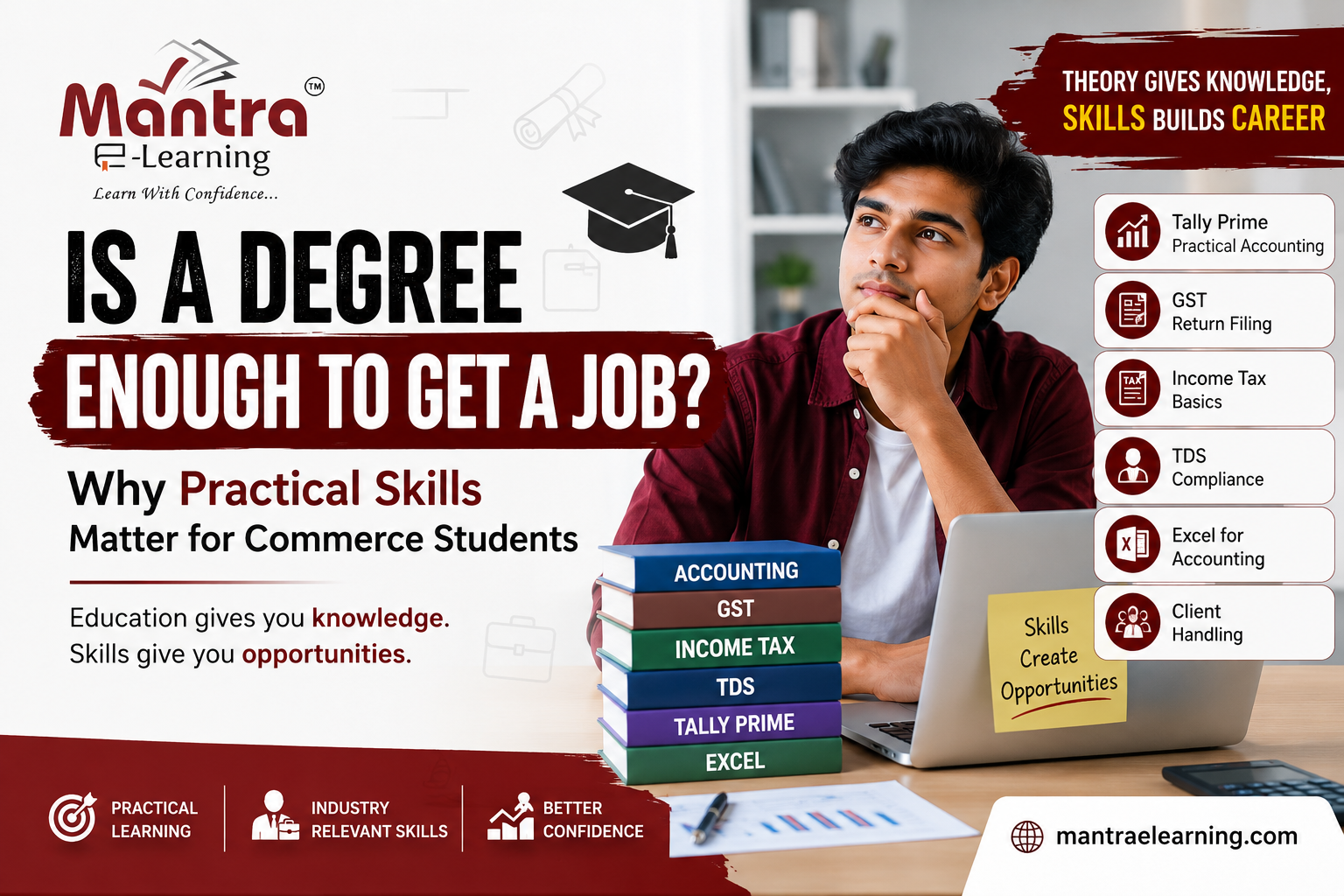
B.Com + Tally Prime + GST + Income Tax + TDS + Excel
can create a much stronger foundation for someone starting a career in accounting and taxation than relying on a degree alone.
Similarly, an M.Com graduate can benefit from practical exposure when transitioning from academic learning into professional work.
The objective is not to replace education with skills.
The objective is to make education useful in the real world.
Why Practical Accounting & Taxation Training Matters
For a fresher, the first challenge is often not simply finding a job. It is demonstrating that they can contribute to an organisation from the beginning.
This is where structured practical training can help.
At Mantra E Learning, the focus is on connecting accounting and taxation concepts with practical workplace requirements.
Instead of treating accounting and taxation as subjects that exist only in textbooks, practical learning can involve scenarios that resemble the type of work students may encounter in accounting offices, businesses, and professional firms.
The focus areas include Practical Accounting, Tally Prime, GST, Income Tax, TDS/TCS, and Excel, along with exposure to practical business situations.
This approach can help students understand not only what a concept means, but also how and where it is used.
Who Can Benefit From Practical Accounting Training?
Practical accounting and taxation training can be useful for:
- B.Com students
- B.Com graduates
- M.Com students and graduates
- Commerce freshers
- Students preparing for accounting jobs
- Candidates looking for entry-level taxation roles
- Students who want to work in CA firms
- Individuals looking to strengthen their accounting skills
- Anyone who wants to move from theoretical knowledge to practical application
If you’re starting your career, you don’t necessarily need to know everything on day one.
But you should continuously work toward becoming someone who can understand the work and perform it confidently.
How to Become More Job-Ready After B.Com
If you have recently completed your B.Com or are still studying, consider following a practical roadmap:
Step 1: Strengthen Your Accounting Fundamentals
Understand journal entries, ledgers, trial balance, financial statements, and basic accounting principles.
Step 2: Learn Accounting Software
Get practical exposure to Tally Prime and understand how businesses maintain their books.
Step 3: Learn GST Practically
Understand GST compliance and practise working with return-related data.
Step 4: Build Income Tax Knowledge
Learn how tax computation and return preparation work in practical situations.
Step 5: Develop TDS Skills
Understand the complete basic TDS compliance process.
Step 6: Improve Excel
Learn the Excel functions and reporting techniques commonly used in accounting work.
Step 7: Practise Realistic Scenarios
Don’t just watch tutorials.
Work with sample transactions, documents, reports, and business situations.
Step 8: Prepare for Interviews
Be ready to explain how you would perform a task, not just define the concept.
This is where your confidence begins to change.
A Degree Is the Beginning, Not the End
A B.Com or M.Com degree is valuable. It gives you knowledge, qualification, and a foundation for your professional journey.
But today’s commerce graduate should think beyond simply collecting qualifications.
Ask yourself:
“If an employer gives me actual accounting work tomorrow, can I handle it?”
If the answer is no, that’s not a reason to panic.
It’s a reason to start building practical skills.
Learn accounting software. Practise GST. Understand Income Tax. Build TDS knowledge. Improve Excel. Work on realistic business cases. Develop communication and client-handling skills.
Because when you combine your degree with practical knowledge, you don’t just become a degree holder.
You become more job-ready.
Ready to Build Practical Accounting & Taxation Skills?
Explore Mantra E Learning’s Practical Accounting & Taxation Training and take the next step toward building workplace-ready skills in accounting, GST, Income Tax, TDS, Tally Prime, and Excel.
Your degree can open the door. Your skills can help you perform once you’re inside.